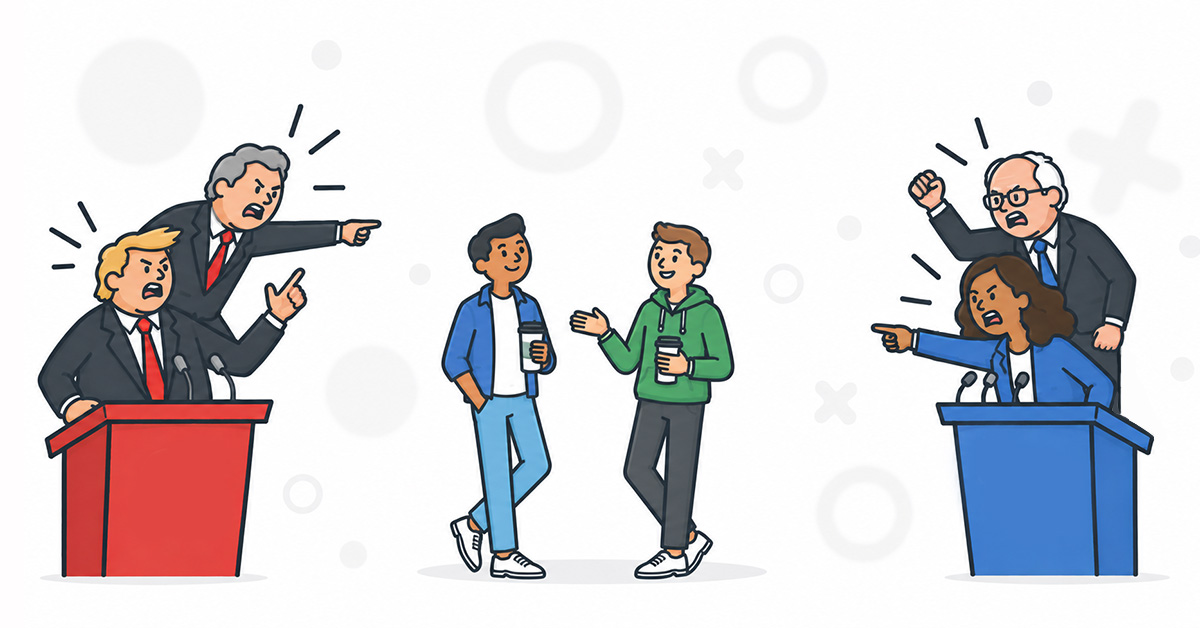
What Americans Agree On
As the fierce partisan battle for Congress reaches its crescendo this week, I want to share some good news: Americans may be more in sync than we realize.
Divisive rhetoric may drive turnout, but our recent research shows it misses a larger reality. A huge swath of voters of all stripes are yearning for many of the same things, citing the same values and upset at the same broken systems.
There’s a real silent majority out there, and it’s largely unharnessed in the current political environment.
A glimpse of this undercurrent of agreement came out of an interesting piece of research we did with the CareQuest Institute for Oral Health late this summer. The study included a national survey of 1,027 likely voters, focus groups in two rural swing districts (northeastern Pennsylvania and upstate New York), and a three-day online qualitative bulletin board with 32 persuadable voters recruited from the country’s most competitive rural congressional districts. One thing that made the research interesting was its goals: Instead of mining for wedge issues, we wanted to see where views converged. Instead of testing our pitch, we set out to just listen to what people want.
Among the surprising takeaways:
- Republicans embrace diversity. When we kicked off our focus groups asking about what people value about America, nearly every voter – including committed Republicans – independently cited the mix of cultures, races and (because it came up a lot) food we have in this country. It was easily one of the top three most beloved national characteristics across the political spectrum. The divisions are probably more around what’s emphasized – the unity is around America as a melting pot, not an emphasis on one race or ethnicity.
- Democratic voters are all about freedom and protecting America’s entrepreneurial spirit. The other American values widely held most dear were grouped under “freedom / choice” (how Americans have more choices) and “land of opportunity” (how anyone can make it here). Lots of caveats were raised about how those values are eroding, but importantly, they’re what voters of all political stripes, including Democrats, want to see protected.
- Everyone wants to blow up our healthcare system. In the focus groups, it was really hard to get people to talk about what they LIKED about the current healthcare system. (The dislike list was huge.) Mostly, the only likes go back to choice – as in choosing providers – and advances in medical technology. Provider choice is really the only must-have. Most voters want more government involvement, including four in 10 Republicans. Only about one in 10 voters want to leave things as they are.
- Pragmatic fixes can win big, bipartisan majorities. We drilled down specifically around oral health and found nine in 10 voters support adding a dental benefit to Medicare, including 97% of Democrats and 85% of Republicans. It was far from the only crowd-pleaser. Expanding VA coverage so all veterans can get dental care is liked or loved by 96% of Democrats and 90% of Republicans. Requiring health insurers to cover oral health: 97% and 78%. Encouraging dentists to accept all types of insurance, including Medicaid and Medicare: 94% and 80%. Incentives for dentists to work in underserved rural areas: 93% and 75%. And 89% of voters, including 78% of Republicans, say congressional candidates should be talking more about the lack of dental coverage in Medicare.
- Voters reward candidates who sound realistic. Participants were deeply skeptical of politicians who “promise everyone everything” on healthcare. When survey respondents sized up two hypothetical candidates, the candidate promising to add dental to Medicare was four times more likely to be trusted by Republicans than the candidate promising Medicare for All.
So why does it feel like we’re at each other’s throats?
Look at what each party’s voters rank as their top healthcare priority. For Democrats, it’s Medicare for All (60% put it in their top three). For Republicans, it’s rooting out waste and fraud (68%). Those are the issues that dominate campaign rhetoric, and they are also the most polarizing. Right behind them, at nearly identical levels, sits a shared priority: lowering prescription drug costs (59% of Democrats, 58% of Republicans).
Here’s one theory. In close races, turnout wins, and nothing drives turnout like a fight. So campaigns lead with the issues that fire up their base rather than the ones that unite. Each side hears the other’s loudest message and concludes that “they” want something radically different. Repeat that every election cycle, and we start to believe it.
A survey can’t prove what’s in a politician’s head, but voters themselves seem to sense it.
“A lot of politicians directly benefit off of us having to struggle,” an independent in Scranton told us.
A Republican in the same group added: “One party can come out with the best ideas and the other party will go against it just because they agreed on that.”
When we stopped talking about parties and started talking about what people actually want – affordable care, the freedom to choose their own provider, a fair shot at a healthy life, a dentist within driving distance – the walls came down fast. That doesn’t make the hard debates disappear. It does mean we have more to build on than the campaign ads would have us believe.
Maybe we’re less divided than we think.

Peter is the founder & chief insights officer of Marketing for Change.

Zophia Kotala is a research analyst at Marketing for Change.
Sign Up
Get insights to help your cause delivered directly to your inbox once a month.
Related Articles
There Are 2 Ways to Ask ‘Why’ – Only 1 Leads to Behavior Change

Psychological Profiles of America’s Uninsured and the Messages that Work for Them
What Gets the Uninsured to Buy Health Insurance? A Look at the Decision-Making Journey