There Are 2 Ways to Ask ‘Why’ – Only 1 Leads to Behavior Change
I recently attended a behavioral science conference filled with more than 200 very smart people dedicated to understanding human behavior. And even here, it happened.
After a presentation on Americans’ beliefs and behaviors around a controversial topic, an expert shook his head and asked, why do they DO that?
The headshake is a clue. This is not a question driven by curiosity. It is judgment. It is an expression of frustration at the stupidity of people who don’t act the way we think they should.
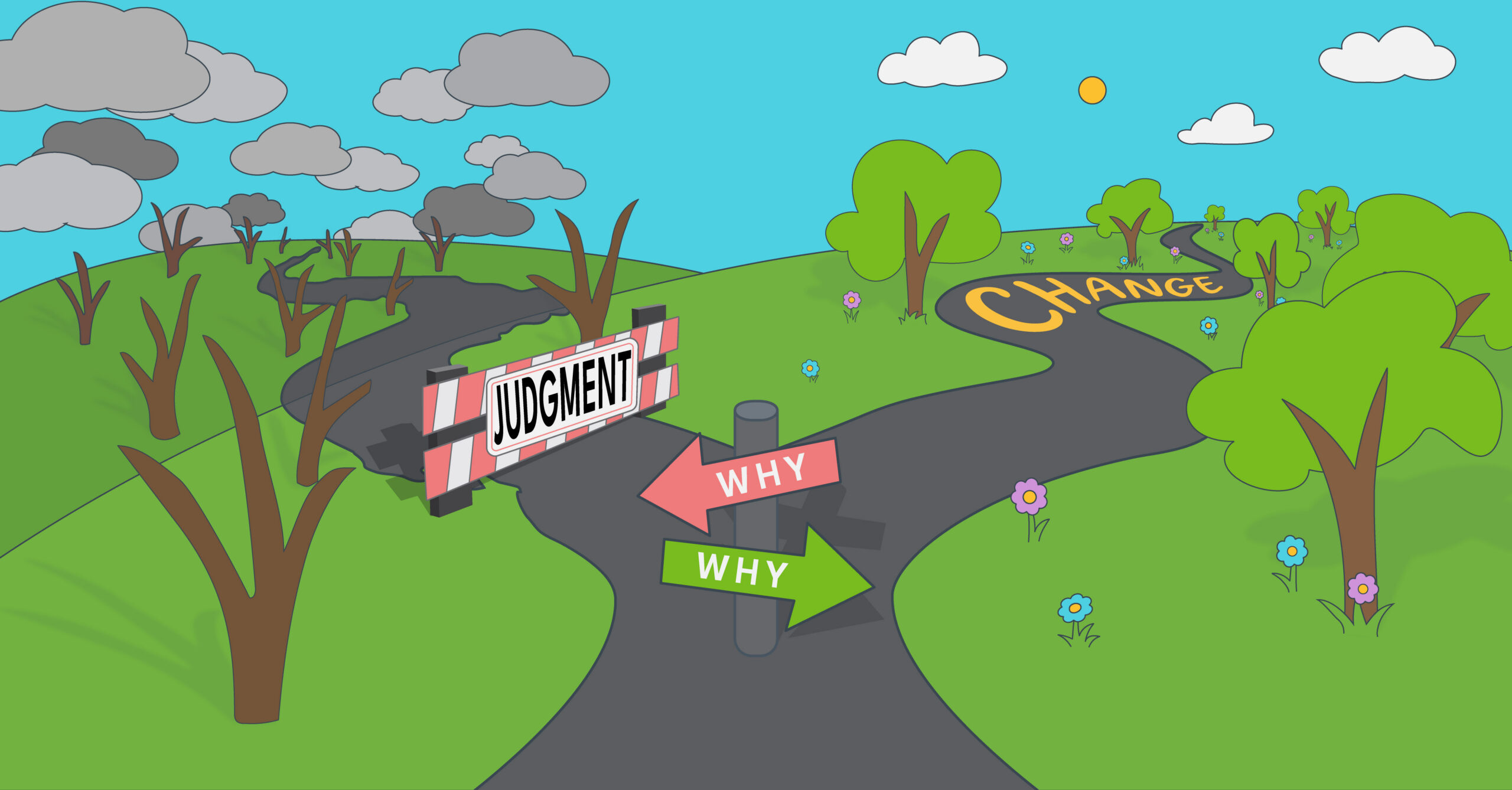
Judgment is a roadblock to change
As human beings, we like to think well of ourselves. We are also quick to think poorly of others, especially if we disagree with them. This leads to a number of behavioral biases, including a key stumbling block for behavior change agents: naive realism.
Naive realism is the conviction that we see the one true version of reality. The psychologist Lee Ross identified three intertwining beliefs that support this bias:
- We believe we see things just as they are. Our observations and opinions feel objective and rational. The idea that our mind is actively constructing a version of reality shaped by our experiences and emotions doesn’t feel true from the inside.
- We think reasonable people will agree. Since we think we see things accurately, it seems clear that any rational, unbiased person looking at the same evidence should reach the same conclusions.
- People who think differently are therefore biased, misinformed, or irrational. Disagreement can only be explained by the other person’s ignorance, self-interest, or ideological distortion. We don’t think, “we see this differently.” We think, “they’re not seeing clearly.”
In fact, behavioral science has shown through experiment after experiment that every perception we have as humans is filtered, every memory reconstructed, and every judgment shaped by prior beliefs. Even – or maybe especially – when we are an expert.
How to reach people who think differently than you
Effective voluntary behavior change begins with understanding the audience perspective. We can overcome naive realism by asking “why” with curiosity, empathy, humility and respect.
What shapes the audience’s understanding? How do these beliefs and behaviors serve them? What might make the desired behavior more attractive within the context of their day-to-day lives? What values do we share?
If we want to accurately diagnose behavioral barriers and motivators, we need to stand in the shoes of the people we are hoping to change and look at reality from their perspective.
So if you catch yourself shaking your head at others’ behavior, know that you are choosing judgment over empathy. It might feel good – we are all human, after all, and humans love to judge.
But if you want to change behavior, change how you ask why.

Sara Isaac is the agency’s chief strategist.
Sign Up
Get insights to help your cause delivered directly to your inbox once a month.
Related Articles
Psychological Profiles of America’s Uninsured and the Messages that Work for Them
What Gets the Uninsured to Buy Health Insurance? A Look at the Decision-Making Journey
When Cost is THE Conversation: What You Need to Know for 2026 Health Insurance Outreach